How to Improve Forage Quality, and What It Actually Does for Your Farm
Forage quality gets discussed constantly in dairy sustainability conversations, but rarely with much practical detail. Most content either treats it as a vague good idea or jumps straight to abstract emissions theory. Here’s the more useful version: what actually changes forage quality, backed by real trial data, and what it delivers once you’ve done it, on milk, on cost, and on your farm’s footprint.
What “forage quality” actually means
Forage quality is usually expressed as D-value, the percentage of digestible organic matter in the dry matter. A higher D-value means more of what the cow eats is actually absorbed and used, rather than passing through undigested. D-value is driven overwhelmingly by one factor: how mature the grass was when it was cut.
The biggest opportunity: cutting date
Research from the Agri-Food and Biosciences Institute (AFBI) in Northern Ireland has quantified this precisely: silage D-value declines by an average of 3.3% for every one-week delay in harvest date. Put another way, waiting even a single extra week to cut can cost you more digestibility than most other management decisions combined. Once grass starts pushing up flowering stems, digestibility can fall by as much as 0.5 units a day, and a one-week delay in cutting after heading has begun can mean losing as much as 3.6 units of D-value.
This is why cutting date, not fertiliser rate or grass variety, is usually the single most important decision behind forage quality.
Multi-cut systems: the practical way to act on this
The direct consequence of the cutting-date finding is that cutting earlier and more frequently, a multi-cut system, consistently produces higher-quality silage than a traditional three-cut approach. AFBI trials comparing three-cut and four-cut systems found that cows offered silage from the four-cut system had higher dry matter intake, higher milk yield, higher milk fat and protein yield, and an improved margin over feed costs, compared to cows on three-cut silage. Farmer-reported experience backs this up too: producers moving to multi-cut systems commonly report dry matter intake increases of 1 to 3 kilograms per cow per day, and multi-cut silage can support 35 to 40% or more of total milk being produced directly from forage, reducing reliance on purchased concentrate.
Multi-cut isn’t free, though, and it’s worth being honest about the trade-offs before recommending it uncritically:
- It requires more land for the same herd, since cutting earlier means lower yield per cut. AFBI’s own comparison found a 100-cow herd over a 180-day winter period would need roughly 19% more land under a four-cut system than a three-cut system.
- The harvest window is narrower. Producing high-digestibility silage means cutting within a relatively tight time frame, which is a real logistical challenge for farms relying on contractors rather than their own machinery.
- Fermentation can be trickier. Grass cut at an earlier, leafier growth stage tends to be higher in nitrogen and lower in sugars, which can make achieving a stable, well-fermented clamp more difficult than with more mature grass.
Getting the wilting and ensiling right
Cutting date sets the ceiling on quality, but poor handling afterwards can waste it. Target dry matter at ensiling is typically around 28 to 30%, achieved through rapid wilting, AFBI trial work reports wilting periods as short as 5 to 28 hours depending on weather conditions, followed by good compaction and a well-sealed clamp. Treating grass with a bacterial inoculant at ensiling, standard practice in the AFBI trials, supports a more reliable fermentation, particularly important for the higher-nitrogen, lower-sugar grass that earlier, more frequent cutting produces.
For maize silage specifically
The same underlying logic (younger, more digestible material) applies differently to maize, where the key factors are variety selection for starch content, harvesting at the right dry matter window (typically 30 to 35% DM), and proper kernel processing so the starch is actually accessible to the cow rather than passing through whole.
What you actually get from doing this well
Higher milk yield from the same or less purchased feed. This is the headline benefit, and it’s well documented: in AFBI’s own trials, moving from a three-cut to a four-cut system directly increased milk yield and milk fat and protein output, not just theoretically but measured in a real feed-to-yield comparison.
Reduced concentrate costs. One UK farm case study reported removing 1.5 kilograms of concentrate blend per cow from the ration after improving first-cut silage quality, while maintaining or improving yield, a direct cost saving that stacks on top of any emissions benefit.
Improved margin over feed costs. This is the metric that ties the yield and cost benefits together, and it’s the one AFBI’s own trials measured directly, not just milk output in isolation, but the net financial return once the higher input costs of multi-cut are accounted for.
A genuine, but easily misread, methane benefit. This is worth restating clearly, because it’s the part most content gets wrong: improving forage quality does not reliably reduce methane per cow, and in some research it can modestly increase it, since more digestible feed means more substrate for rumen fermentation. The real benefit shows up as methane per litre of milk produced, since better forage supports meaningfully more milk from a similar methane cost. If your reporting tracks methane per cow rather than methane per litre, a successful forage quality programme can look like it achieved nothing. It’s the wrong number, not a failed strategy.
Improved nitrogen use efficiency. More digestible forage tends to convert dietary nitrogen into milk protein more effectively, which means less nitrogen is excreted and available to be lost as ammonia or nitrous oxide, a metric increasingly used across the dairy sector as a proxy for how well a farm’s whole system is performing.
Practical starting point
- Know your current cutting date relative to heading, not just relative to the calendar. This single piece of information tells you more about your silage quality than almost anything else.
- Consider whether a multi-cut system is realistic for your land base and contractor access, since the land and logistics trade-offs are real and farm-specific, not universal.
- Get the wilting target right (28 to 30% DM) and use an inoculant, since good cutting timing can still be undermined by poor fermentation.
- Track methane per litre of milk, not per cow, when assessing whether the strategy is working.
- Treat the milk yield and cost benefits as the primary business case, with the emissions intensity improvement as a genuine, well-evidenced, secondary benefit, not the other way around.
How this fits inside a mitigation toolbox
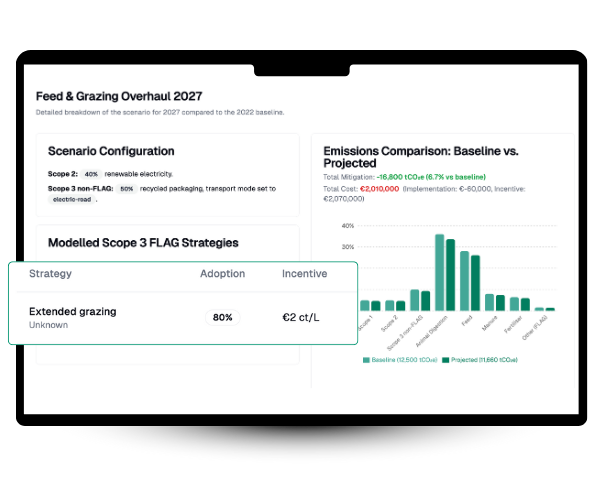
A credible modelling approach treats forage quality as an emission intensity opportunity, not a raw methane one. Rather than assuming a fixed percentage reduction, a proper model starts from your farm’s actual grass and maize silage digestibility, lets you test what happens if that digestibility improves, and recalculates both the emissions and the milk production response together. The two have to move together to mean anything. A tool that only shows the emissions side, without the corresponding production change, will always understate what forage quality is actually worth.
Forage quality is one of the more actionable strategies available, precisely because the biggest single factor, cutting date, is entirely within a farm’s control and doesn’t require new capital investment to start improving. The challenge isn’t in doing it. It’s in measuring and reporting the benefit using the number that actually reflects what changed.
Sources: AFBI (Agri-Food and Biosciences Institute), “AFBI Research demonstrates improved performance within a ‘multi-cut’ silage system”; PMC, “Performance of Dairy Cows Offered Grass Silage Produced within Either a Three- or Four-Harvest System”; Fane Valley, “Making Quality Silage”; Farmers Weekly, “Q&A: Experts answer farmers’ multi-cut silage questions”; O’Neill et al. (2011), enteric methane in grazing dairy systems.