Key Insights from Spain’s Dairy Innovation, Science and Sustainability Summit
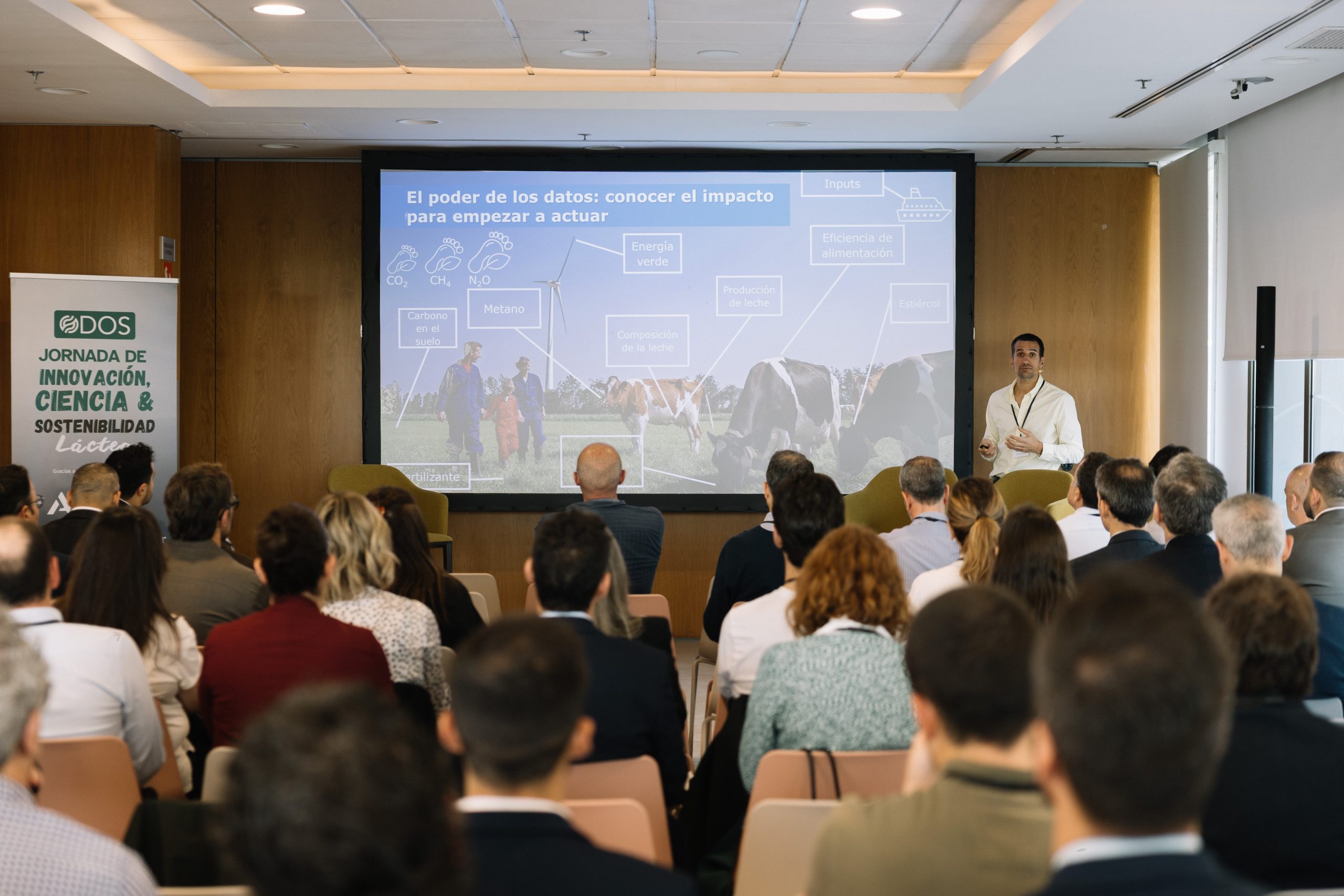
FrieslandCampina, CSIC, Kaiku, COVAP and more gathered in Valencia for ODOS's Dairy Innovation, Science and Sustainability Summit.
On 21 April 2026, ODOS hosted the Dairy Innovation, Science and Sustainability Summit in Valencia, Spain. The event brought together over 80 professionals from across the dairy supply chain for a full day of science-led discussion, panel debates and knowledge sharing on one of the sector’s most pressing challenges: how to reduce the environmental footprint of dairy farming, at scale, in practice.
The event featured two keynote presentations and six expert panels, covering biodiversity, slurry management, fertilisers, the processors’ perspective, enteric methane, feed additives and animal nutrition. Speakers included senior researchers from the CSIC, programme managers from FrieslandCampina, sustainability directors from cooperatives including Kaiku, COVAP and CAPSA, and specialists from leading mitigation solution providers including dsm-firmenich, Alltech, Cargill, Trouw Nutrition, BASF Agro, Biopranaworld, EuroChem, Grupo Fertiberia, Eco-sens and TIMAC Agro. Moderation was provided by experts from SGS and Medrar Innovation Office.
ODOS organised the event with a clear purpose: to bring the Spanish dairy industry together around a shared evidence base, and to accelerate the exchange between researchers, processors, cooperatives and solution providers that is essential for progress.
That purpose is grounded in a specific reality. Spain is one of Europe’s significant dairy producers, yet it remains behind several northern and western European countries in sustainability infrastructure, emissions measurement and supply chain data maturity. Countries like the Netherlands, Denmark and Ireland have spent over a decade building farm-level carbon accounting systems and traceability frameworks. Spain is earlier in that journey.
This creates a genuine opportunity. Spain can learn from what has worked elsewhere, adopt proven solutions faster and avoid the dead ends that other markets spent years navigating. The tools exist. What is needed now is data, coordination and implementation at scale.
Biodiversity Is the Next Frontier for Dairy
Pablo Modernel, Programme Manager for Farm Nature at FrieslandCampina, opened the conference with a keynote on biodiversity and the dairy sector. The topic is moving rapidly from voluntary commitment to industry priority.
The context is significant. Of the nine planetary boundaries that Earth system scientists use to define a safe operating space for humanity, seven have now been crossed. Biodiversity loss and disruption of the nutrient cycle are among the most critically exceeded. For the dairy sector, which depends directly on land, grassland ecosystems and nutrient flows, this is a material business risk.
FrieslandCampina’s biodiversity strategy is one of the most advanced in the global dairy industry. The company monitors farm-level biodiversity impact across six key performance indicators: greenhouse gas emissions, nitrogen-soil balance, ammonia emissions, local protein production, permanent grassland coverage, and nature and landscape. The monitoring tool was developed in partnership with the WWF and Rabobank.
The results demonstrate that systematic measurement drives improvement. In 2024, FrieslandCampina member farms achieved a 9.8% reduction in greenhouse gas emissions compared to 2023. The company allocated 228 million euros in sustainability premiums to member dairy farmers in 2025, tied directly to measurable performance across animal health and welfare, climate, biodiversity and pasture grazing.
Modernel also highlighted the future of biodiversity monitoring. Remote sensing tools for habitat quality assessment, AI-powered bird species monitoring through platforms such as Chirrup.AI, and environmental DNA (eDNA) analysis for species diversity are all moving from research into field application.
One important limitation was raised: there is still no standardised biodiversity footprint equivalent to a carbon footprint. Methodologies vary significantly, which currently limits comparability across supply chains. This is an area where the science is still catching up with the urgency.
Key takeaway: Biodiversity is transitioning from a reputational consideration to a core sustainability priority. Farm-level measurement, regenerative land management and nature-positive targets will define the next phase of dairy sustainability leadership.
Enteric Methane: The Science, the Measurement Gap and the Solutions
Dr. David Yáñez-Ruiz, Senior Research Scientist at the CSIC, delivered the conference’s most technically detailed session. It covered the production, measurement and mitigation of enteric methane in dairy cattle.
Enteric fermentation accounts for approximately 49% of total agricultural greenhouse gas emissions in the European Union. Methane has a global warming potential 28 times that of CO2 over a 100-year period, and an atmospheric lifetime of approximately 12 years. For dairy processors calculating supply chain emissions, enteric methane from supplier farms is consistently the largest single emissions source.
How enteric methane is produced
Methane in ruminants is not produced by the animal itself. It is produced by methanogenic archaea, microorganisms in the rumen that consume the hydrogen generated during carbohydrate fermentation. This process represents an energy loss of approximately 6% of gross energy intake, which is why reducing enteric methane is both an environmental and a productive opportunity.
The measurement challenge
Accurate measurement of enteric methane at farm level remains technically and economically challenging. Respiration chambers are the scientific gold standard but are not scalable to commercial farms. Automated head-chamber systems such as GreenFeed offer practical on-farm measurement, but adoption remains limited. Most national emissions inventories therefore rely on IPCC emission factors combined with activity data on feed intake and diet composition.
The accuracy of these estimates depends on the quality of that activity data. Without reliable farm-level information on dry matter intake, diet composition and forage digestibility, emission estimates can vary substantially. This has direct consequences for processors building credible supply chain carbon inventories.
Mitigation options and their evidence base
Yáñez-Ruiz presented the main mitigation levers available, organised by the level of the production system they target:
Herd management through genetic selection, reproductive efficiency and animal longevity delivers 1 to 12% methane reduction, with permanent cumulative gains of 0.5 to 1% per year as herd genetics improve.
Diet composition and forage digestibility delivers 1 to 15% reduction. Higher-quality, more digestible forage reduces the methane conversion factor significantly. Maize silage, for example, ranges from a conversion factor of 6.9% at low digestibility to 4.3% at high digestibility.
Feed additives targeting rumen methanogenesis deliver 2 to 60% reduction depending on the compound. The most evidence-backed approved product in the EU is Bovaer® (3-NOP) by dsm-firmenich. It inhibits methanogenic archaea directly and delivers approximately 30% methane reduction at a dose of 1.2g per animal per day. It is the only feed additive approved for dairy cattle as a zootechnical additive in the EU, approved in 2022, and is backed by over 117 published scientific studies.
The session also addressed adoption barriers. Most feed additives offer no direct productive benefit to the farmer, meaning uptake depends on financial incentives from processors or cooperatives. Traceability of additive use is a further challenge. Without confirmation that a solution was administered consistently and at the correct dose, additive-based reductions cannot be credibly claimed in supply chain carbon inventories.
Key takeaway: Enteric methane is dairy’s single largest mitigation opportunity. Proven solutions exist across herd management, nutrition and feed additives. Scaling them requires farm-level data infrastructure, robust traceability systems and incentive alignment between farmers and processors.
Slurry Management: Emissions and Resource Recovery at Farm Level
The Slurry Management panel, moderated by Hugo Criado, CEO and Founder of Medrar Innovation Office, and featuring speakers from Biopranaworld, Alltech and BASF Agro, examined the emissions associated with manure management and the solutions available to reduce them.
Manure management is the second-largest source of agricultural methane after enteric fermentation. It is also a significant source of nitrous oxide, a greenhouse gas with a global warming potential approximately 265 times that of CO2 over a 100-year period. In liquid slurry systems, which are common across Spain’s intensively managed dairy farms, emissions during storage and application represent a quantifiable and addressable part of the farm’s carbon footprint.
The panel explored how biological and chemical additives, adapted storage management and precision application technologies are enabling farms to reduce these emissions while recovering nutrients. The discussion emphasised the importance of integrating slurry management into whole-farm sustainability strategies. Decisions around storage, application timing and soil conditions all interact with emissions outcomes and need to be considered together.
Key takeaway: Slurry management represents a significant and actionable source of farm-level emissions reductions. Solutions exist across storage, additives and application management. Integration into whole-farm carbon accounting is increasingly essential.
Fertilisers: Decarbonising Crop Nutrition Across the Dairy Supply Chain
The Fertilisers panel, moderated by Tomas Navarro, Business Development Manager for Sustainability at SGS, brought together EuroChem, Grupo Fertiberia and TIMAC Agro to address the greenhouse gas emissions embedded in crop nutrition.
Nitrous oxide emissions from synthetic fertiliser application are a globally significant source of agricultural greenhouse gases. In dairy systems that rely on cultivated forages or purchased feed crops, fertiliser-related emissions can represent a material proportion of supply chain farm emissions. Yet they receive less attention than enteric methane in most processor sustainability programmes.
Grupo Fertiberia presented its approach to decarbonising fertiliser production, including the development of low-carbon formulations designed to reduce the emissions intensity of production. The panel also examined the performance of protected fertilisers. These formulations slow nitrogen release and reduce nitrous oxide volatilisation at soil level, with evidence from grassland and forage systems directly relevant to dairy.
EuroChem addressed the adoption challenge. Sustainability-aligned fertilisation practices often require changes to established farm routines. The panel identified agronomic advisory support and precision agriculture tools as key enablers of wider adoption.
Certification and verification of emission reductions from fertilisation innovations emerged as a central theme. The ability to credibly measure and report reductions at the field level is becoming a commercial differentiator across the supply chain.
Key takeaway: Fertiliser-related emissions are a significant and often underweighted component of the dairy supply chain carbon footprint. Low-carbon fertiliser formulations, precision application and independent certification are moving from innovation to industry standard.
The Processors’ Perspective: Data, Farmer Engagement and Investment
The Processors’ Perspective panel, moderated by Alejandro Vergara, CEO of ODOS, brought together Rubén Hidalgo, Director of Impact Investment at Grupo Central Lechera Asturiana (CLAS), Naroa Sarasua, Sustainability Manager at Kaiku, and Ana Alicia Bolívar, Sustainability Manager at COVAP.
The three organisations represent different models of dairy processing in Spain. Their convergence on several key points was instructive.
Farm-level data is the critical constraint. Every participant identified the collection of reliable, granular farm data as both the most important investment and the most significant operational challenge. Without accurate data on emissions sources, input use and farm practices, supply chain carbon inventories rest on assumptions.
Farmer engagement determines outcomes. Cooperatives have a structural advantage: direct, long-term relationships with farmer members create channels for support, education and incentive delivery. Both Kaiku and COVAP emphasised that sustainable farming practices cannot be mandated without corresponding financial and technical support. The design of those support mechanisms is as important as the sustainability targets themselves.
Impact investment frameworks for dairy are still developing. Rubén Hidalgo offered a candid assessment of the current state in Spain. The metrics needed to evaluate sustainability investments, balancing financial return, emissions impact, farmer welfare and supply chain resilience, are still being standardised. This standardisation is a prerequisite for mobilising significant private capital toward dairy sustainability transition at scale.
Key takeaway: Processors are the central actors in scaling dairy sustainability across the supply chain. Progress depends on farm-level data quality, structured farmer support programmes and investment frameworks that capture the full value of sustainability performance.
Feed Additives and Animal Nutrition: From Research to Supply Chain Integration
The afternoon’s Feed Additives and Animal Nutrition panels brought together specialists from Alltech, Cargill, dsm-firmenich, Trouw Nutrition and Eco-Sens to examine how nutritional strategies and feed additives can reduce emissions intensity at farm level and how to integrate these solutions across dairy supply chains.
Feed additives: evidence base and scaling challenges
The scientific evidence for feed additive efficacy in methane reduction is well-established. The commercial and logistical challenges of scaling adoption are more complex.
Measurement and verification are fundamental to commercial credibility. Feed-based emission reductions can only be claimed in supply chain carbon inventories if they are supported by documented traceability. This requires coordination between feed mills, farmers, veterinary advisors and data platforms that most supply chains have not yet built.
Feed mills are a critical integration point. Nutritional solutions for emissions reduction are typically incorporated at the feed mill level rather than applied directly on farm. The relationship between solution providers and the feed mill network is therefore central to adoption at scale.
Animal nutrition: longevity, efficiency and emissions intensity
Trouw Nutrition addressed a dimension of emissions reduction that often receives less attention than additives: the role of animal longevity and productive efficiency in reducing emissions intensity. A dairy cow that reaches seven or more lactations rather than the current average of two to three produces substantially more milk per unit of lifetime feed intake and rearing cost. Nutritional strategies that support animal health, fertility and productive lifespan are both an agronomic and an environmental priority.
Eco-Sens addressed the measurement and verification of nutritional interventions in sustainability programmes. This points toward a common infrastructure need shared across all the afternoon sessions: farm-level data systems capable of integrating feed records, animal performance data and emissions calculations in a format that is auditable and actionable.
Key takeaway: Feed-based mitigation solutions are scientifically proven and commercially available. Scaling adoption requires traceability infrastructure, feed mill integration and farmer incentive structures aligned with processor sustainability targets.
Conclusion: The Gap Is Not Scientific
What the Dairy Innovation, Science and Sustainability Summit confirmed is that the scientific and commercial foundations for dairy sustainability transition in Spain are in place. The emission factors are understood. The mitigation solutions, from Bovaer to protected fertilisers to improved herd management, are approved, tested and commercially available.
The gap that remains is operational.
Spain’s dairy sector needs farm-level data infrastructure that can support credible supply chain carbon accounting. It needs traceability systems that can verify what interventions were applied, where and when. It needs incentive structures that make sustainability investment worthwhile for farmers. And it needs the kind of cross-sector collaboration, between researchers, processors, cooperatives, solution providers and data platforms, that events like this one exist to build.
The conversations that started in Valencia on 21 April are the beginning of a longer process. We are committed to continuing them.